Spring is here — and with it, Happy Earth Day.
While many of us are looking forward to longer days and warmer weather, the escalating threat of climate-related disasters looms large, especially at this time of year. The human and environmental toll in Canada has been profound. In financial terms, the Insurance Bureau of Canada estimates the cost of climate disasters over the past decade at $37 billion.
As Canada makes an existential pivot away from overreliance on the U.S. market, we cannot afford to treat climate risk as a side issue. The question of how much we do now to mitigate the systemic risks climate change poses to the Canadian and global economy — and to our capital markets — will shape our competitiveness for years to come.
A bright spot emerged in Ottawa last week, where policymakers, financial sector leaders, and researchers gathered to discuss unfinished business: the creation of a mandatory framework for climate disclosures by Canadian public issuers. Organized by the Institute for Sustainable Finance and MP and sustainable finance leader Ryan Turnbull, and facilitated by Ontario Chamber of Commerce CEO Daniel Tisch, the event drew about a dozen members of Parliament. The message was clear: the case for mandatory climate disclosures in Canada has never been stronger, and the economic and political moment for progress is here.
If you have followed this issue, you know that last year the Canadian Securities Administrators paused implementation of the Canadian Sustainability Standards Board’s recommendations, citing the U.S. Securities and Exchange Commission’s reversal on similar rules for American markets.
Since then, Donald Trump has declared his desire to make Canada the 51st state, and Prime Minister Mark Carney’s now historic Davos speech underscored the need for Canada to diversify its markets and help build a more resilient international order. A few months before Davos, the federal government began framing its climate agenda through the lens of climate competitiveness.
Mandatory Climate Disclosures and Canada: fear of missing out?
Simply put, mandatory climate disclosures would help Canadian and international investors make better decisions by giving them consistent information about how companies identify, assess, and manage climate risk — and how they are preparing their businesses for the future.
The rest of the world has already recognized the importance of these metrics, especially for long-term investors. As the Carney government deepens trade and investment relationships with “middle power” countries, it is worth asking where those partners stand on mandatory disclosure.
Among OECD countries, BRICS economies, and other major emerging markets, a supermajority now either already has mandatory climate disclosure requirements in place or has scheduled them to begin by January 1, 2028.
Another way to view this is through market exposure: 53 stock exchanges, representing a combined estimated market capitalization of $58.85 trillion, are moving forward with mandatory climate disclosures. In other words, exchanges representing 42% of global market capital are embracing these requirements; if U.S.-listed capital is excluded from the calculation, that share rises to 85%.
The laggards — those with no current plans to move ahead in any form — are few, including the United States, Argentina, Kuwait, Saudi Arabia, Iran, Brunei, and Russia.
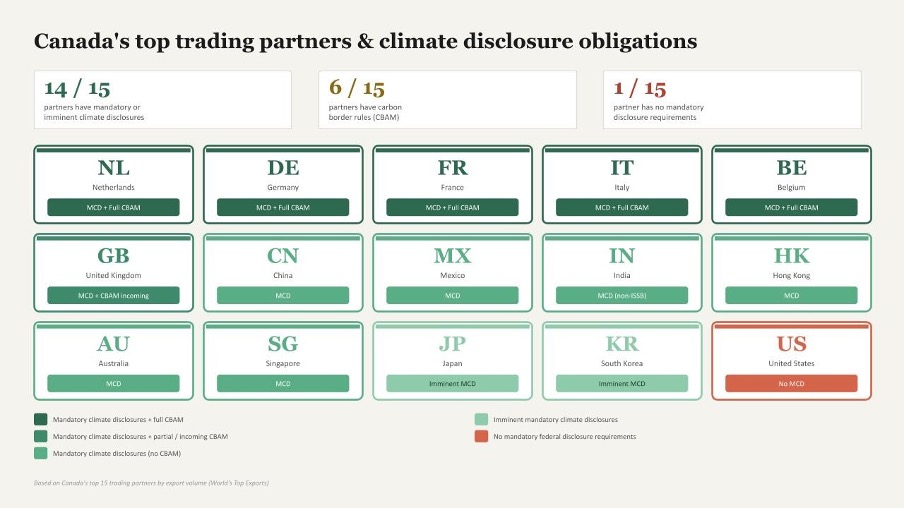
It is also important to note that EU member states have implemented carbon border adjustment mechanisms as of January 2026, which now impose specific disclosure requirements on Canadian exporters to the EU. Companies that have reduced their carbon footprint — and those already paying an industrial carbon price domestically — will be better positioned to benefit.
Myth versus fact
The American market is not moving entirely in the opposite direction. While MAGA forces have worked hard to reverse momentum on a range of sustainable finance measures, there is still more happening south of the border than meets the eye. Seven states are moving forward with disclosure requirements: California, New York, Illinois, New Jersey, Washington, Minnesota, and Colorado.
By August 2026, companies with global revenues above USD $1 billion that do business with California will be subject to state emissions reporting requirements under SB 253. Climate disclosures are also required of companies trading carbon assets or making net-zero claims under AB 1305. Similar laws have been proposed, though not yet enacted, in the other six states, including draft legislation on the reporting of climate-related financial risks.
These seven states accounted for about 35% of Canada’s exports to the U.S. in 2025, or roughly a quarter of all Canadian exports.
Notably, none of the “red states” adopting anti-ESG measures have objected to the disclosure of climate-related information to investors.
Disclosures are not the be-all and end-all of climate competitiveness – they simply provide data to support decisions and actions. That makes them table stakes in realigning our markets to be resilient in the face of climate risk, so we are including them in a suite of policy asks that SHARE is currently pursuing with investors, policymakers, and regulators to unlock opportunities that the benefit Canada’s economy, Canadian and global investors, and the Earth we all call home.